
Summary
Trade-in programmes are often classified as nice-to-haves or sustainability initiatives. That framing is accurate but limiting, as the commercial impact is distinct, measurable, and immediate.
The execution can be designed in a way that doesn’t cheapen the brand and aligns with the brand’s values. Yet, every planning cycle, it loses out to something with a seemingly clearer near-term revenue line; this is wrong.
Every month without a trade-in programme is a month in which lapsed customers are not returning, retail customers remain unknown, and products the brand designed, produced, and marketed circulate on secondary markets with no relationship to the brand at all.
This paper aims to quantify the costs of inaction and make the case that the programme is both more financially productive and more operationally straightforward than the planning cycle suggests.
What is trade-in for store credit?
Trade-in for store credit is where brands offer to trade used apparel from customers in exchange for store credit. The “returned” stock can then be re-sold, donated, upcycled or recycled depending on the brand’s objectives.
Why is Trade-in Better Than Loyalty or Other Retention Tactics
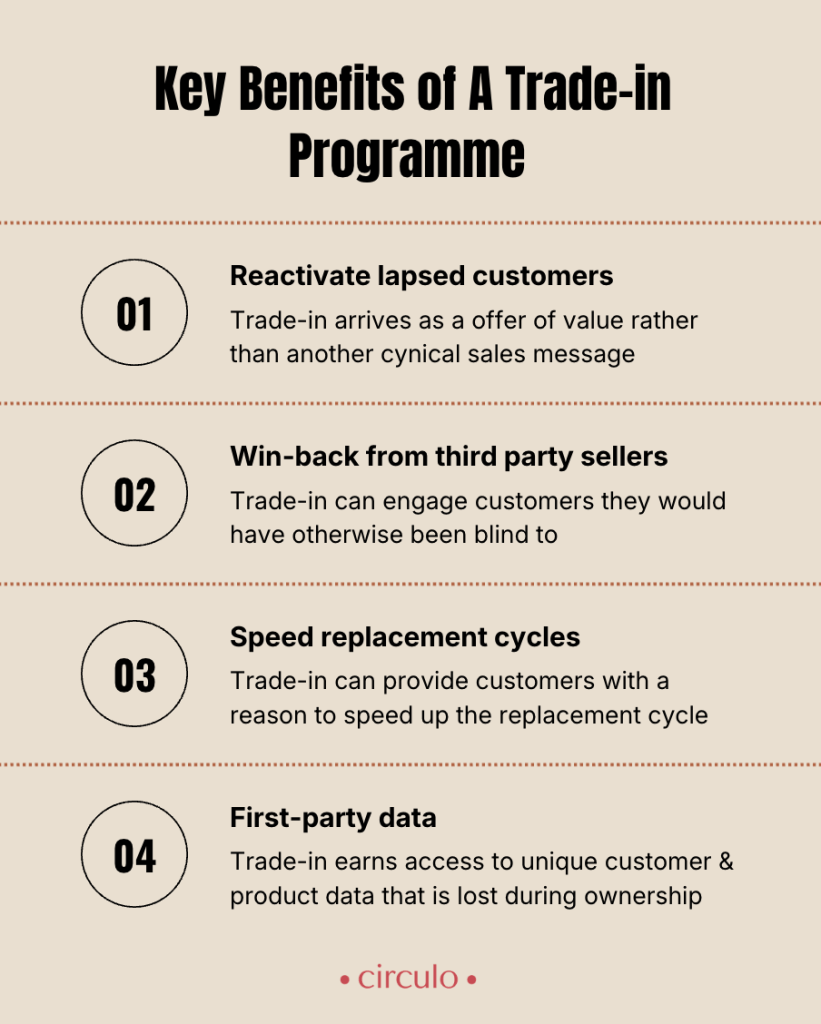
Reactivation
Most brands above a certain scale have a substantial population of customers who bought once or twice and have since gone quiet. The question is how to bring these lapsed customers back.
Most brands will send one-sided marketing emails based solely on the time since the last purchase.
Reactivating those customers through conventional marketing is increasingly difficult. Inbox filtering, AI-driven spam classification, and GDPR constraints mean that a reactivation email sent to someone whose last purchase was two years ago may never be seen, and even if it is, it arrives as an ask rather than an offer.
A trade-in offer is structurally different. It is a service: your old product has residual value, and we will give you store credit. That framing has a materially better open and conversion rate because the recipient is receiving something, not being sold something.
The downstream economics are well-documented. Across multiple independent studies, 68% of customers who receive store credit go on to make a further purchase. When they do, they spend an average of 20 to 40% above the credit value. The credit produces a transaction equivalent far larger than its face value.
Win-back
For brands with any meaningful wholesale or multi-retailer distribution, a substantial portion of the customer base is unknown. They bought through a stockist. The brand has no purchase record, no contact details, and no future commercial touchpoint. They are customers in every meaningful sense except that the brand cannot reach them. Trade-in changes that.
Trade-in is one of the few mechanisms that changes this. A customer who bought a jacket through a retailer three years ago and brings it back for trade-in credit is, for the first time, registering directly with the brand. They are now known. The relationship has started. Research from ThredUp and GlobalData, published in 2025, found that 47% of consumers are more likely to make their first direct purchase from a brand if it offers a trade-in programme. The programme is an acquisition channel for customers already using the product.
The same logic applies to the secondary market. Products that do not have a branded trade-in option still enter the second-hand market — they simply do so through eBay, Vinted, and Depop, at prices the brand does not control, with no relationship to the brand’s own infrastructure. A trade-in programme redirects some of that flow. The customer who would have sold their jacket online for £40 instead brings it directly to the brand for £30 in-store credit. The brand recovers the product and earns the next purchase.
Replacement cycles
The replacement cycle for quality outdoor apparel is long. A jacket bought in 2022 will not naturally require replacement until 2026 or later. Between purchase and replacement, the brand has limited grounds for direct contact beyond generic marketing messages that land in an increasingly filtered inbox.
A trade-in prompt, sent 18 to 24 months after purchase and timed to a new season launch, is not a marketing message. It is a service communication: this product has aged, it has value, and here is what we will give you for it. Customers who receive contextual, lifecycle-relevant communications respond at significantly higher rates than those receiving broadcast marketing. The touchpoint also carries first-party intent data: a customer who initiates a trade-in is signalling that they are in market.
Critically, when this interaction happens through the brand’s own infrastructure, the data it generates belongs to the brand. Purchase history, trade-in behaviour, product preferences, and redemption patterns are captured in the brand’s own systems and are available for product planning, targeted reactivation, and commercial forecasting. That is a qualitatively different asset from the engagement data generated through third-party platforms.
First-party data
Third-party data is degrading fast. Cookies are disappearing, inbox filters are getting smarter, and AI tools now mediate a growing share of how customers discover and research products. What holds its value is the data customers volunteer. A trade-in is exactly that: a customer confirming who they are, what they own, what condition it is in, and that they are in market, all in one interaction. Few mechanisms produce data that specific. None produce it as willingly.
How To Get The Highest ROI From a Trade-In Programme?
The natural instinct when designing a trade-in programme is to offer generous credit in order to drive uptake. The data points in the opposite direction. Blackhawk Network’s 2022 Global Gifting Study, which surveyed 2,165 consumers across retail categories, found that lower-value store credits yield dramatically higher spend-to-credit ratios. A $10 credit typically generates around $50 in total transaction value. A $500 credit generates perhaps $600.
This is not a quirk. It reflects the psychology of store credit. A customer holding a modest credit uses it as a trigger and a contribution toward something they already want. A customer with a large credit balance is more likely to spend exactly the credit amount and stop. The sweet spot for outdoor apparel, based on the category analogues in the research, is a credit of £20 to £40. At that level, the credit functions as permission to upgrade, not as a full subsidy.
This also resolves the accounting concern. A trade-in programme issuing modest credits to a large number of customers does not create a significant balance sheet liability. It creates a predictable, short-duration obligation. Data show that 70 to 80% of store credits are redeemed within three to six months of issue, and breakage on unredeemed credits is approximately 10% or less.
What To Do With The Traded-In Stock?
The answer is more straightforward than the question implies.
The most common internal objection to trade-in is the question of what happens to the returned stock. The answer is more straightforward than the question implies.
Donate, recycle, repair, resell, or some combination thereof – the discrete next step, or combination of next-best actions, is a brand-level decision based on the experience any given brand wants to optimise for.
Circulo’s client, the golf apparel brand Bogey, directed traded-in product to a select few charities that the brand enables customers to choose from. They don’t touch the product at all but do make a by-piece donation to the chosen charity.
Circulo’s client, sustainable fashion brand Toast, runs a multi-level initiative wherein products can be donated or repaired. Toast offers free repair. Donated items may be selected for resale, upcycle-then-resale, or donation to Traid (the only UK charity that generates all of its funding solely through the sale of second-hand clothing).
Brands can triage items in good condition to branded resale (best for brand control and first part data) or to a resale platform who will attempt to sell the product via various means and share a cut of the proceeds with the brand (best of ease of execution but poor for control and data); we advise all but luxury brands to see this latter option as a meaningful alternative revenue stream.
Footwear brand Vivobarefoot (via Rivivo.com) has the specialist capabilities and partners to recycle stitched, glued, and multi-material footwear – they do this for their own shoes and for other brands, which means they gain a wealth of other-brand data and create a de facto lead-gen tool for those who haven’t yet bought their product.
There is a mature UK ecosystem for exactly this. Specialist operators including CTR Group and Yellow Octopus, alongside 3PL providers with established returns management capability, can handle condition grading, warehousing, fulfilment, and resale without the brand needing to build any internal infrastructure. The operational complexity is real, but it is outsourceable, and the partners who do this at scale do it well.
What is The Easiest Way To Start With Trade-In?
Trade-in programmes look complex to operate. Condition assessment, logistics, refurbishment, resale. But modern platforms handle all of this, and there are several entry points that can be running within weeks rather than quarters.
Trade-in programmes look complex to operate. Condition assessment, logistics, refurbishment, resale. But modern platforms handle all of this, and there are several entry points that can be running within weeks rather than quarters.
Reactivation email campaign to lapsed customers
The fastest path to measurable return is a targeted email campaign to customers whose last purchase was 12 months or more ago. Send a trade-in offer specific to the product they bought, with a clear credit value and a simple self-assessment form. No new website infrastructure is required to run a pilot. A landing page and a credit fulfilment workflow are sufficient to test response rates before committing to wider rollout.
The scale of the opportunity is not trivial; Circulo’s clients have seen a 7-10% uptake on such campaigns. A brand with several hundred thousand inactive customers and a 7-10% pilot conversion rate is looking at a revenue event that is many multiples higher than the meagre set-up costs.
Social or search paid win-back campaigns
For customers who came through retail and are not in the brand’s CRM, a paid or organic social media campaign or a search-driven campaign can drive trade-in enquiries. A customer searching for options to trade in an outdoor jacket is expressing high intent. A brand with a visible programme at that moment captures a customer who would otherwise transact entirely outside its ecosystem.
Built-in Email Flows
For direct customers, a brand can set up a trade-in email flow at a set interval after purchase. This is a great way to get customers to create accounts too, for those who’ve made this a priority.
An automated trigger that fires 18 to 24 months after a direct purchase, aligned with a seasonal launch, is one of the most relevant communications a brand can send. It is not a discount offer. It is a lifecycle signal: the product has aged, the season has changed, and here is what your old jacket is worth toward the new one. Brands running these triggers report materially better open and click rates than standard promotional sends.
A trade-in option sits alongside the order history in the customer account. The same interface that currently offers a reorder button can offer a trade-in initiation. The customer sees the product they bought, clicks to trade in, completes a condition self-assessment, and receives credit to their account.
Integration with the repair, warranty or other workflows
For brands already running repair services, the natural integration point is at the end of a repair assessment. When a product is assessed as beyond economic repair, the customer currently faces a dead end. At that moment, a trade-in offer converts the interaction into a commercial one. The customer is already engaged with the brand around this product. The offer has high relevance and, in practice, high conversion.
The Case For Acting Now Rather Than Next Cycle
There are several annual events with a built-in incentive to run a trade-in campaign – one is the change of seasons, and the other is Christmas.
As most will redeem their store credit within 90 days (programs can be designed to increase this probability), an early autumn campaign will provide incentives for an autumn refresh and reactivate potentially thousands of customers ahead of the Christmas season. With marketing spend highest and least efficient in the fourth quarter, a trade-in campaign is a no-brainer.
Conclusion
The commercial returns from a well-run trade-in programme compound over time. The first cohort of reactivated customers generates revenue and first-party data. That data improves targeting for the second cohort. The brand’s owned pre-owned channel begins to appear in organic search results for customers looking for alternatives to the secondary market. The programme builds its own momentum.
The cost of waiting is the mirror image of that compounding. Every month without the programme is another month when lapsed customers do not return. Another month in which retail customers remain unknown. Another month in which the secondary market for the brand’s products continues to develop without the brand’s involvement. The opportunity does not disappear. It accumulates, but not for the brand.
Brands with active, known, returning customer bases are worth more than brands dependent on acquisition — not in an abstract sense, but because the metrics that reflect genuine commercial health — direct customer density, repeat purchase frequency, first-party data depth — are the metrics that distinguish durable businesses from those held together by marketing spend. Trade-in contributes to all of them, at a cost per acquired or reactivated customer that is substantially lower than paid acquisition. That case is available to make now.
About Circulo
Circulo is a composable post-purchase platform for product brands and retailers, consolidating warranty administration, service management, trade-in, spare parts management, and recommerce into one globally scalable system.
We offer a pay-as-you-reactivate trade-in tool that can be easily embedded in an email or SMS campaign, or on any website. It’s integrated with most e-commerce platforms, including Shopify, is available in English (British and American), Italian, and several other languages, and has many pre-built logistics integrations such as Royal Mail, DHL, and DPD. Set-up takes approximately one week and includes guidance on program design to maximise desired business outcomes.
Get in touch for a quick demo at hello@circulo.tech
Sources:
https://returngo.ai/the-power-of-store-credit-refunds/